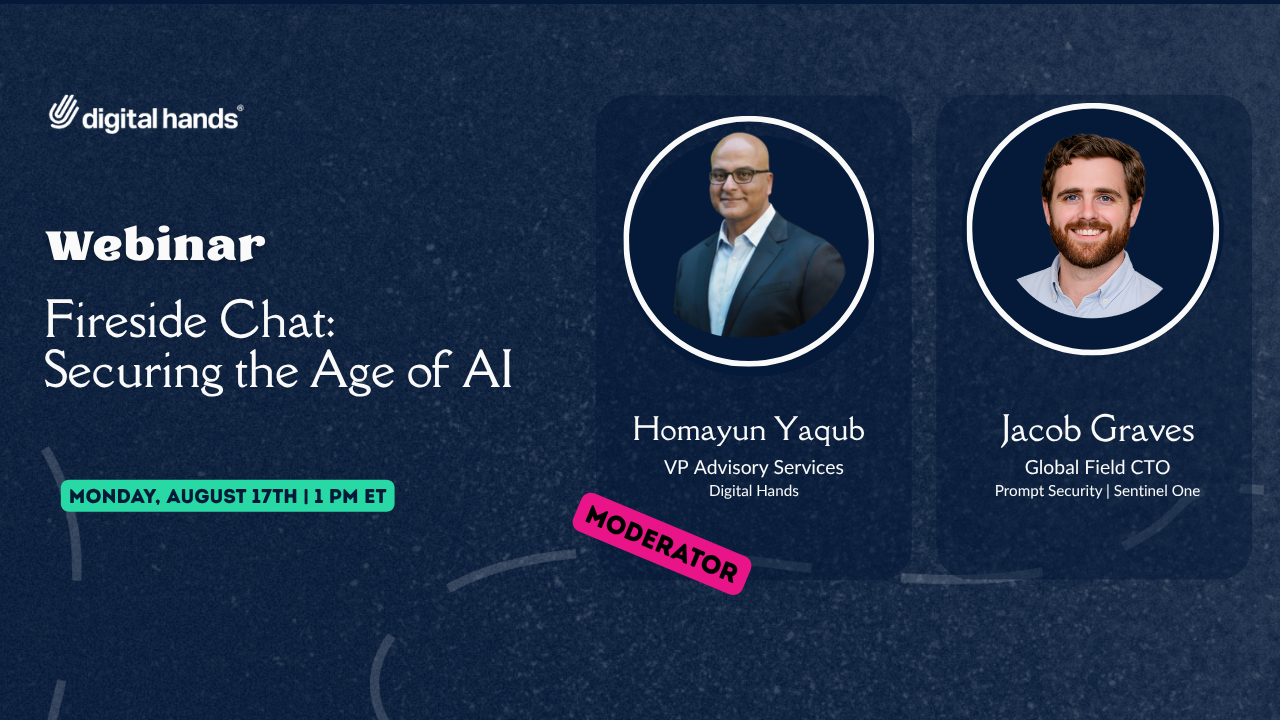
Securing the Age of AI
A working conversation on identity, detection, and control in the era of autonomous agents
Two things are happening at once inside the enterprise, and many security programs are treating them as separate problems. Employees are pouring sensitive data into GenAI tools faster than anyone can see, let alone govern. And AI agents are quietly becoming a new population of non-human identities – authenticating, holding entitlements, calling APIs, and delegating to other agents, usually on service accounts and long-lived credentials that were provisioned once and never revisited.
An AI agent is both an AI that can be manipulated and an identity with standing privilege – which means a prompt injection doesn't stop at data leakage; it becomes privilege escalation. Securing how AI is used and securing the identities AI acts as are two halves of the same picture, and the overlap is where the real risk lives.
Homayun Yaqub from Digital Hands and Jacob Graves from SentinelOne sit down for a candid, no-slides conversation drawn from frontline advisory work and threat research. No product pitch – but frank exchange on what they're seeing, for leaders who have to make decisions now.
What we'll get into:
- Why the AI security conversation splits into two circles – securing AI usage and securing AI identity – and why the overlap (agentic AI holding real privilege) is the part most programs aren't watching
- How prompt injection turns into privilege escalation when the manipulated agent is authenticated and entitled – and why identity posture and threat detection have to converge to catch it
- What it looks like in the field: shadow AI and data leakage on one side; over-provisioned service accounts, credentials that never rotate, and agent delegation chains no one owns on the other
- A realistic set of moves for the next 12 months – starting with visibility into how AI is actually being used, then governance and least-privilege for the identities behind it – that don't require rebuilding your stack
Who should attend: CISOs, security architects, and identity and access leaders responsible for what happens when machines start acting on their own.